
Please Be Cringe.
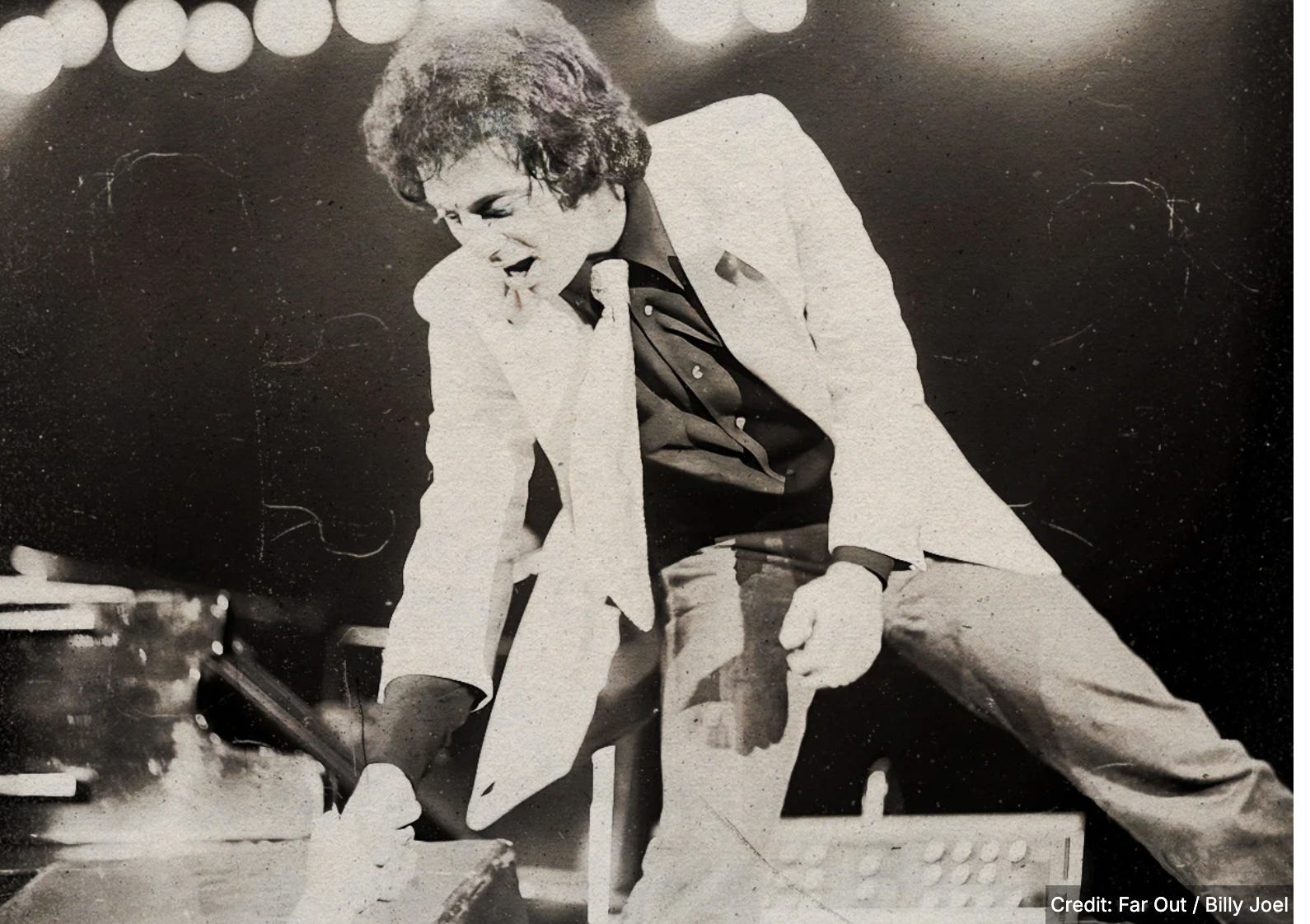
Make like Billy Joel. (Or Louise Glück.) (Or Eddie Vedder.)

Welcome to This Week Paul Likes!
Normally I give you the three recs, the tip, the quote, but this week I went long on something that bothered me, something I used to be.
I want to talk about that New York Times Magazine list of the 30 best living American singer-songwriters—and not because Billy Joel was left off it, as was (let’s see) Rufus Wainwright and James Taylor and Tyler, The Creator and, if we’re talking generation-defining talents, Kanye West. (Though I get why the Times excluded Kanye.)
Rick Beato has fun assembling a list of the rock or county Hall of Fame songwriters, the multi-platinum artists, the billion-plus-download singers or lyricists left off the list. It’s absurd.
Which is the point. As someone who worked in magazines for 20 years, you assemble a list like the Times Magazine’s to create debate. Consider that list a success: The nation is still talking about it two-plus weeks later.
What I want to consider today is the Times’ critics response to the debate, a podcast they hosted to justify their picks and exclusions. What bothers me is what appears over and over in that response, a very particular worldview of certain creative types. It rises above the group’s discussion, hangs there as some toxic black cloud, thundering and belching and ultimately befouling everything it rains on, the critics most of all.
This worldview goes way beyond music criticism.
Kids, you do not want to be like Jon Caramanica.
To understand why, let’s return to Rick Beato. He recorded a second video this week that went super-viral, had more than 10 times the views of the Times’ podcast.
Beato goes hard on two fronts.
The critics’ education. None of them has a music degree. None, as far as we know, plays any instrument professionally or with a passable level of dexterity.
Their musical ignorance isn’t nearly as bad as their narcissism and self-aggrandizement.
Let’s take Beato’s first point.
It makes me queasy. If only people who practice a craft may critique it, then this would mean, say, female writers should be banned from NFL locker rooms. Not cool. Mina Kimes joined the staff of ESPN the Magazine somewhere around 2012 or 2013, I forget. She came from Bloomberg but quickly showed she could do much more than write the enterprise features she pitched us or we assigned her. Mina loved the NFL. Now, I played high school football but it was obvious in my conversations with Mina she knew more about the game—more of its Xs and Os strategy, and at the highest level—than I did.
Today, among other things, she’s an NFL analyst for the network. She’s just as funny and smart and incisive in front of the camera as she used to be in the Mag’s office.
To be fair to Rick Beato, I don’t think in the above video he’s saying, If you don’t play music or have a music degree you can’t critique it. I think he’s instead saying, If you’re going to be a critic without any hands-on knowledge of the form, you must make a deep study of music and engage with any piece or album on its terms. What is it trying to do? Does it succeed? Why does it move you? Or, Why does it fail to?
Come to the genre with a respect and generosity of spirit and degree of honesty that, well, Mina Kimes has covering the NFL.
Which brings me to point No. 2, and the thing Beato and I both hate. The writer glancing over his shoulder, smirking at the audience as he types, hoping readers will be just as impressed with his take as he is with himself.
I was going to share the transcript of Jon Caramanica’s rationale for leaving Billy Joel off that list of best songwriters. A transcript doesn’t capture the condescension and smarm though. You need to see it.
So, stop reading. Go to the halfway point of the Beato video, when Caramanica responds to why Joel was left off the list.
Join me when you’re done.
The self-congratulation, the flippancy and dismissiveness of not just the public’s taste but points of fact—it’s a bad look for Caramanica and the other critics on the panel. Billy Joel’s songwriting really is studied in music schools. Billy Joel really did have that residency at Madison Square Garden for more than a decade and really did sell out all those MSG shows.
I’m not even making a Billy Joel argument here. I get why people think he’s uncool. (Though I’d say it’s hard to deny the musical craft of, say, “Summer, Highland Falls” or “She’s Always a Woman.”)
I’m saying I pity Jon Caramanica. That preening three-minute clip shows he will never in his life create unabashedly. For the joy of it. For the unbridled ambition of it. He’s too anxious to please, anxious to be noticed. He’s too uncertain of himself. If that three-minute clip is any guide he’s afraid to show the world what he’s capable of for how it might in turn critique him.
I may be wrong. I don’t know Caramanica at all. I may have just reduced him to his worst three minutes. If I have and if Caramanica is reading this, I apologize. But I know the type. When I was young I was this type, the sort who sneers at the world from a defensive half-crouch because if he falls from here, well, he’s told himself it won’t hurt as much.
It hurts more.
That’s the broader point to share, the thing that goes way beyond music criticism.
I cared so very much in my young writing life what others thought of me. Maybe we all do, but I don’t remember my stories in the late 90s and early 2000s so much as their comment sections. I’d obsessively refresh a page throughout the day after a story posted, aching to know what someone new considered of me. I’d wake up at 1 a.m. to see which randos had commented on a piece since the story’s posting at midnight. When social media came to dominate how stories were distributed, one Friday night I stayed up until 6 am arguing with Twitter usernames like “@peanutboil681” about FBI crime stats and how my interpretation of their influence on Boston mayoral races was dead wrong.
Not healthy. Also highly addictive. The praise, when it came, felt amazing. But because I validated my work through strangers’ opinions, you can probably guess how I felt when those opinions were unfavorable.
And so, my sneering worldview developed, my defensive half-crouch, where I looked at what I might write through the prism of how it might be received. By commenters, by my editors, by the internet’s metrics themselves, about how many people were reading any one piece and how deep they were getting into it before bouncing to something else: If you write in the digital age, the digital world will very quickly tell you how to write and what to say. And it will reward you for writing within its orthodoxies.
It rewarded me. I moved from a job in Phoenix to another in Dallas and ultimately to one in Boston, the pay always a little better, the prestige at each outlet always a little shinier, the need to be well received ever-more neurotic. And so I would find a still-lower position in my defensive half-crouch, afraid of falling. Afraid of being myself.
Maybe you can read it in these stories, too: A technical proficiency, perhaps, but little vibrancy, little emotional warmth. Certainly no risk in the writing. This is the problem with the half-crouch worldview. You’re looking over your shoulder, smiling at the audience, thinking you’re giving it what it wants. You’re really denying yourself what you want.
You’re afraid of falling and yet don’t realize how it hurts more to stay where you are.
Eddie Vedder saved me.
One night in my late 20s, in my apartment in Boston, my wife asleep next to me, I crept out of our bedroom. I couldn’t sleep. I don’t remember the story I’d just published but do remember checking the comments that afternoon and many—or was it only some?—were not kind. My need to tap dance on the page in the hopes of pleasing editors or angry readers morphed, as I sat there on my couch in the middle of the night, into a frustration. Why do I care about these people? When, if ever, will I just go for it and be myself?
It didn’t feel great to ask these questions—I’d been asking them a lot—and so I pulled up YouTube to numb and distract.
I’m a child of the 90s and had listened to Pearl Jam’s MTV Unplugged album maybe 500 times by that point. I’d watched Pearl Jam recordings on YouTube too many times to count. That night, though, when I watched Eddie Vedder sing “Black,” I saw something I’d overlooked.
He was just going for it. That performance was well beyond technical proficiency. It wasn’t even a song. “Black” in that Unplugged recording was Eddie living out his pain.
Eddie was so fully himself in that performance, so nakedly himself, that it lived on some communal plane. You felt what he felt, watching him, listening to him.
That was the point, I realized. Not technical proficiency. Not what Pearl Jam’s record label thought of the recording or even what the audience members that night did. No. Be so unabashedly yourself, create unabashedly, that your experience, your say, your words, might be the thing that breaks through and gets others to say, Yeah, I’ve felt that way before, too.
You see it everywhere once you start to notice it. Toni Morrison wrote with this unashamed creativity, the expression of her whole self. Christopher Nolan directs movies that way. Tom Junod writes magazine pieces that way. Ted Gioia writes Substack essays that way, as does Sam Kriss. Louise Glück wrote poetry that way.
I could go on. The list is very long.
It’s 15-plus years for me after that night in Boston, and in every magazine piece and book since I’ve tried to just say what I want. Sometimes it burns me. Yesterday, for instance, I had lunch with my editor in New York for Book No. 3 and she spent a good chunk of our lunch relaying how awful the first 50 pages were. Fifteen years ago that conversation would have destroyed me. Yesterday, it stung, of course, but what I said was I had experimented with something in those first 50 pages. I could find another way to relay what I wanted to say. In fact, what I have in mind now will quicken the narrative’s pace—the editor was right; it needs to be quickened—and very likely eliminate that which she finds grating.
But I do not second guess standing tall these days, creating unabashedly, even with elements of cringe or “try hard.” I’ve found it’s the only way to write. What readers really want is for you to be yourself on the page. That’s what they respond to: your idiosyncratic voice. Your originality. Your whole self.
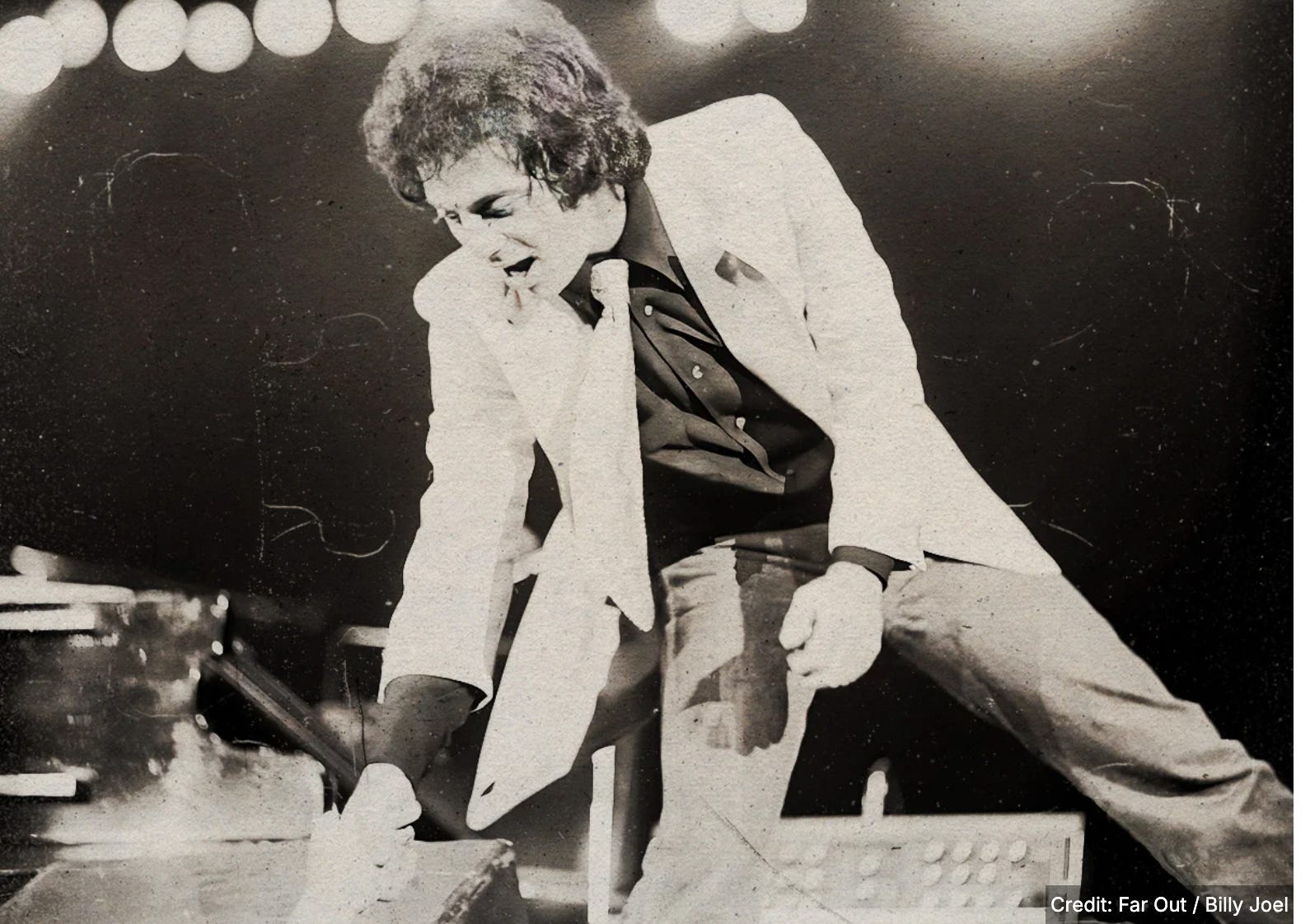
That’s what all people respond to. No one will remember that Jon Caramanica and The New York Times think Billy Joel is uncool. He is uncool. He puts all of himself into so many of his songs.
And for that reason people will listen to “The Piano Man” for generations to come.
Thanks, Paul. :) BTW, my 16yo son recently discovered "Piano Man" and puts it on in the car often, along with "My Life."